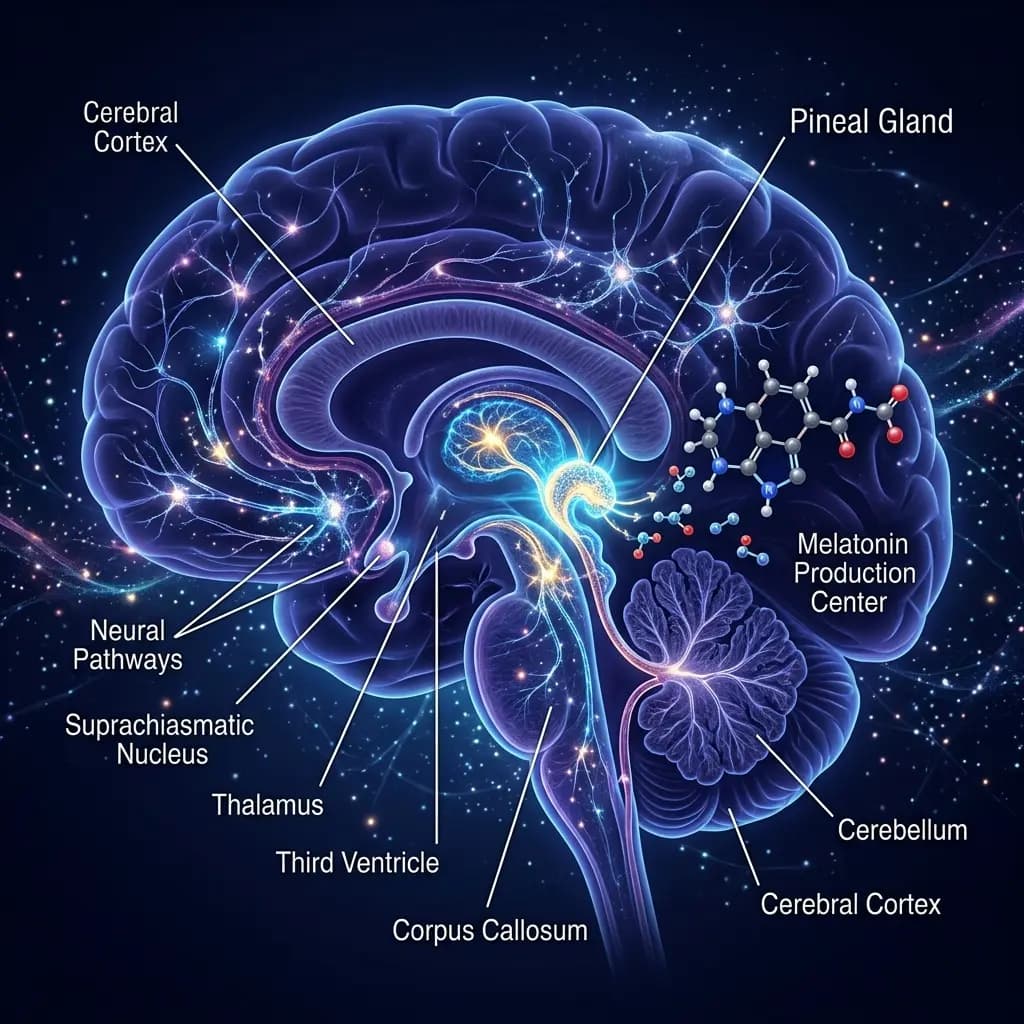
La Glande Pinéale : L'Horloge Maîtresse du Cerveau et son Rôle dans le Vieillissement Cognitif (2026)
La glande pinéale est minuscule — mais son impact sur la santé cérébrale, la qualité du sommeil et le vieillissement cognitif est énorme. Guide scientifique 2026.
The Most Underappreciated Organ in Your Brain
Tucked inside the geometric center of the brain, weighing barely 150 milligrams, the pineal gland is arguably the most underappreciated organ in the human body. It has no direct connection to the conscious brain; it operates in the dark, quite literally — its primary function activated only during darkness. And yet the scientific literature is increasingly clear: the health of your pineal gland may be one of the most important determinants of how well your brain ages.
This guide covers the biology of the pineal gland, why it progressively declines with age, what calcification means for your cognitive health, and what evidence-based strategies exist to support it.
Pineal Gland Anatomy and Function
The pineal gland sits at the posterior border of the third ventricle, between the two cerebral hemispheres. It is a neuroendocrine transducer — converting neural signals (specifically photic information about light and darkness) into hormonal signals (primarily melatonin) that synchronize the entire body to environmental time.
The Melatonin Synthesis Pathway
The pineal gland's primary product is melatonin (N-acetyl-5-methoxytryptamine), synthesized through a 4-step enzymatic pathway:
- Dietary tryptophan → 5-hydroxytryptophan (5-HTP) via tryptophan hydroxylase
- 5-HTP → Serotonin (5-HT) via aromatic amino acid decarboxylase
- Serotonin → N-acetylserotonin via arylalkylamine N-acetyltransferase (AANAT) — the rate-limiting enzyme, activated by darkness via the SCN → pineal nerve pathway
- N-acetylserotonin → Melatonin via hydroxyindole-O-methyltransferase (HIOMT)
This cascade is elegantly dependent on darkness — light exposure anywhere in the retina (including from phone screens) acutely suppresses AANAT activity, halting melatonin synthesis. The average modern adult, with chronic blue-light exposure in the evening, may have a blunted melatonin peak compared to pre-industrial humans.
Melatonin's Roles Beyond Sleep
Melatonin is frequently reduced to "the sleep hormone." This is an understatement:
- Antioxidant: Melatonin is a potent free radical scavenger — more effective than Vitamin E per molecule in some assays. It crosses both the blood-brain barrier and blood-mitochondria barrier, providing antioxidant protection where other antioxidants cannot reach.
- Neuroprotection: Melatonin activates the Nrf2 pathway — the master cellular defense transcription factor — upregulating superoxide dismutase, catalase, and glutathione peroxidase throughout neural tissue. In animal models of Alzheimer's and Parkinson's, pineal-derived melatonin is protective against amyloid-beta aggregation and dopaminergic neuron loss.
- Anti-inflammatory: Melatonin inhibits NF-κB activation — suppressing neuroinflammatory cytokine production in microglia. Neuroinflammation is now considered a central driver of all major neurodegenerative conditions.
- Circadian synchronization: Every organ system in the body has circadian clocks (CLOCK, BMAL1, PER, CRY gene networks). The pineal's melatonin signal synchronizes all peripheral clocks. Disrupted pineal output → desynchronized peripheral clocks → metabolic, cardiovascular, immune, and cognitive dysfunction.
- Neurogenesis: MT1 and MT2 melatonin receptors are present in the hippocampal dentate gyrus — an area capable of forming new neurons throughout adult life. Melatonin receptor signaling supports hippocampal neurogenesis, with implications for memory and cognitive reserve maintenance.
Pineal Calcification: The Silent Age-Accelerator
One of the most important — and least discussed — aspects of pineal physiology is its propensity to calcify. Pineal calcification (the accumulation of calcium phosphate crystals, called "brain sand" or corpora arenacea) is not a disease per se, but a common age-related phenomenon with significant functional consequences.
Prevalence
- Detectable in postmortem studies in approximately 1% of children under 5 years old
- Increases to approximately 40% by age 20
- Reaches 60-90% prevalence in adults over 60 in developed countries
- Rates are significantly higher in countries with fluoridated water supplies (fluoride appears to accumulate in pineal tissue at concentrations up to 300ppm — higher than bone or enamel — and is associated with accelerated calcification)
Functional Consequences
Calcified pineal tissue has reduced pinealocyte (functional cell) density and therefore reduced melatonin synthesis capacity. Multiple human studies have confirmed the calcification-melatonin relationship:
- A 2000 study in Pineal Research found individuals with heavily calcified pineals had significantly lower melatonin levels than age-matched controls with minimally calcified glands
- A large cross-sectional study found pineal calcification severity correlated with cognitive performance scores — independent of age as a confounding variable
- Pineal calcification severity correlates with increased Alzheimer's risk in some longitudinal studies, though causation vs. correlation remains under investigation
What Accelerates Calcification?
- Fluoride accumulation (municipal water supply, dental products)
- Calcium dysregulation (low magnesium, vitamin K2 deficiency)
- Electromagnetic field (EMF) chronic exposure — limited but emerging research
- Chronic artificial light-at-night (ALAN) suppressing melatonin → disrupting pineal cell metabolism
- Age-related decline in antioxidant enzyme activity in pineal tissue
Evidence-Based Strategies to Support Pineal Gland Health
1. Light Hygiene
The most powerful modifiable factor. Blue light (460-480nm peak) from screens is the primary suppressor of pineal melatonin secretion. Recommendations: dim warm-color lighting (>3000K) after sunset; no bright screen exposure within 90 minutes of bed; use blue-light-blocking glasses in the evening; prioritize bright natural light within 30 minutes of waking (to set the SCN clock that governs nocturnal melatonin peak timing).
2. Magnesium Optimization
Magnesium is the primary physiological calcium antagonist. Adequate magnesium status inhibits pathological calcium crystal formation in soft tissue including the pineal. An estimated 50-70% of Americans are below the RDA for magnesium. Best dietary sources: pumpkin seeds (550mg/100g), dark chocolate, almonds, spinach. Supplemental forms: Magnesium glycinate (highest bioavailability, minimal laxative effect) or Magnesium threonate (crosses blood-brain barrier — specific to brain tissue magnesium repletion).
3. Vitamin K2 (MK-7)
Vitamin K2 activates Matrix Gla Protein (MGP) and osteocalcin — proteins that direct calcium to bones and teeth, preventing its deposition in soft tissue including blood vessels, kidneys, and potentially the pineal gland. K2 MK-7 is found in fermented foods (natto — highest source at 1000mcg/100g), some aged cheeses. Supplemental K2 MK-7 at 100-200mcg/day is the practical approach for most people.
4. Tryptophan Optimization
Melatonin synthesis requires adequate tryptophan availability. Dietary protein from turkey, eggs, cheese, and nuts provides tryptophan. Ensuring adequate carbohydrate intake at dinner improves insulin-mediated tryptophan transport across the blood-brain barrier. Chronic low-protein or low-calorie diets may limit melatonin precursor availability.
5. Botanical Nootropic Support
Several botanical compounds have evidence for supporting the neurological environment in which the pineal operates:
- Ginkgo Biloba: Enhances cerebral microcirculation — critical for the pineal gland's exceptional metabolic activity; mild MAO-B inhibition preserves serotonin (melatonin precursor) levels
- Shilajit: Fulvic acid supports mitochondrial function in pineal pinealocytes; trace mineral profile supports antioxidant enzyme activity; may assist in heavy metal chelation from pineal tissue
- Lemon Balm (Melissa officinalis): GABA-ergic support enhances sleep onset → ensuring complete darkness phasing that activates AANAT for melatonin synthesis
- Bacopa Monnieri: BDNF upregulation supports neural network health in the brain structures connected to the pineal-sleep-cognition axis
Products combining these botanical approaches in a bioavailable format — like Pineal Guardian X — represent an intelligent multi-mechanism strategy for long-term pineal and cognitive health maintenance.
Signs Your Pineal Gland May Need Support
- Difficulty falling asleep or staying asleep — especially if this has worsened with age
- Feeling "un-rested" despite adequate sleep hours
- Poor adaptation to time zones (jet lag) or shift work
- Increased sensitivity to artificial light in the evening
- Progressive cognitive fog, especially related to sleep deprivation
- History of night-shift work, chronic blue-light exposure, or high fluoride intake
Conclusion: Your Pineal Gland Deserves Intentional Care
The pineal gland is one of the body's most fascinating and underappreciated regulatory organs. Its progressive calcification — accelerated by modern environmental factors including artificial light, dietary mineral imbalances, and fluoride exposure — silently reduces the melatonin output that protects brain tissue from oxidative damage, regulates sleep architecture, and synchronizes every physiological clock in the body.
Supporting pineal health through light hygiene, mineral optimization, and evidence-based botanical supplementation is one of the most proactive things an adult can do for long-term cognitive health and sleep quality. Unlike most lifestyle interventions, the benefits operate through mechanisms that are biologically active for decades — starting from the first week of implementation.