Meilleurs Nootropiques Cerveaux 2026 : Ginkgo, Bacopa, Shilajit — Comparaison Clinique
De Ginkgo Biloba à Shilajit — quels ingrédients nootropiques ont vraiment des preuves cliniques ? Nous classons les meilleurs suppléments cérébraux.
The Nootropic Market in 2026: Evidence vs. Hype
The global nootropic supplement market exceeded $4.9 billion in 2024 and is projected to reach $8.3 billion by 2030. This explosive growth has produced a market where genuinely evidence-backed botanical nootropics coexist with expensive placebos. Understanding the difference requires reviewing the clinical literature rather than the marketing materials.
This comparison evaluates the most commonly used nootropic brain health ingredients by: mechanism specificity, clinical evidence level, dose requirements, and synergistic potential with other compounds.
Tier 1: Well-Characterized Clinical Evidence
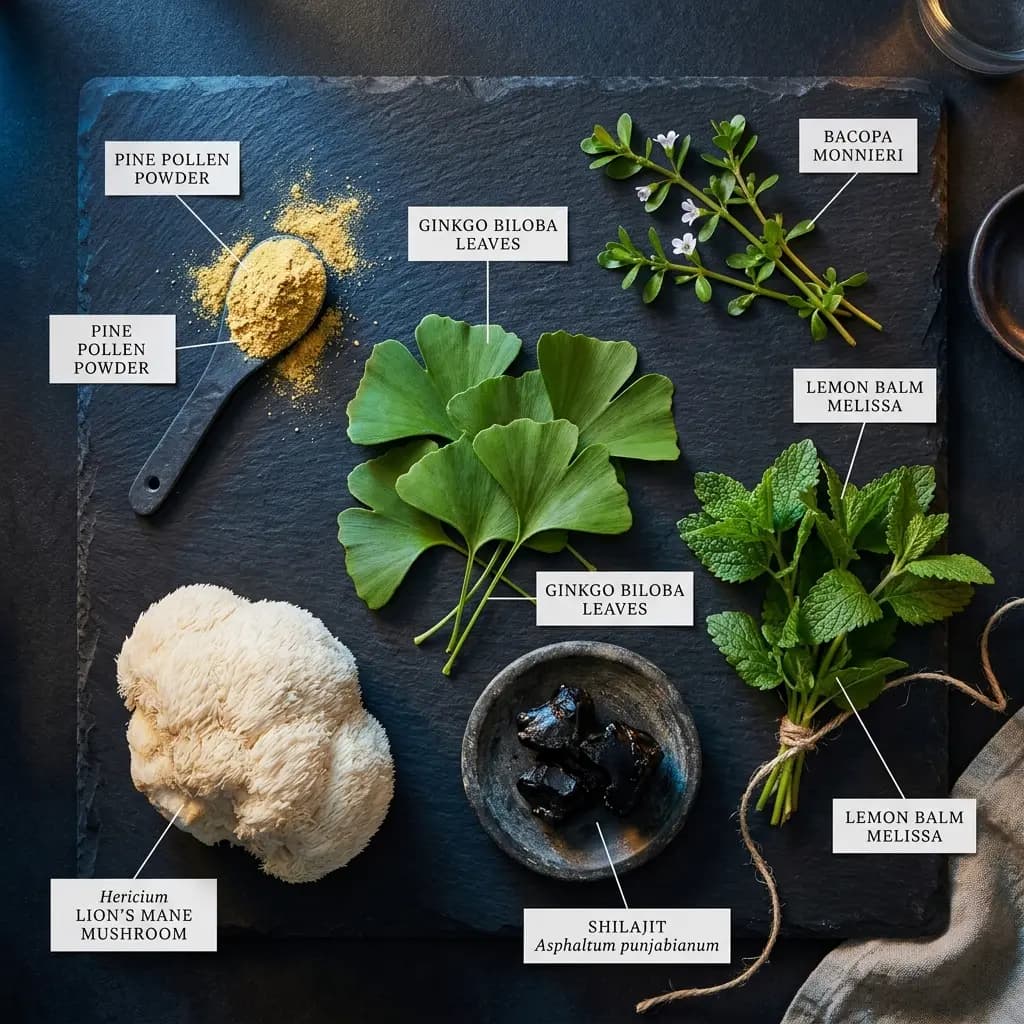
Ginkgo Biloba (EGb761) — Cerebrovascular & Neuroprotective
Evidence: Class A — 300+ published human studies; Cochrane Review confirms cognitive support in aging adults.
Mechanism: Vasodilatory flavonol glycosides → improved cerebral microcirculation; PAF inhibition → reduced neuroinflammation; mild MAO-B inhibition → preserved monoamine neurotransmitter levels; direct antioxidant activity in neural tissue.
Clinical dose: 120-240mg standardized EGb761 extract (24% ginkgo flavone glycosides, 6% terpenoids). Lower doses without standardization are subtherapeutic.
Best outcomes: Memory, attention, and executive function in adults 50+; circulation-related cognitive symptoms; altitude sickness prevention.
Notable: A 2014 meta-analysis of 36 RCTs confirmed statistically significant improvements in cognitive composite scores for Ginkgo EGb761 vs. placebo — one of the strongest evidence bases in botanical nootropics.
Bacopa Monnieri — Synaptic Remodeling & Memory
Evidence: Class A — 9 RCTs confirmed in 2016 systematic review; consistent memory improvements replicated.
Mechanism: Bacosides A and B promote dendritic branching (BDNF upregulation) and synaptic density → enhanced memory encoding and consolidation; acetylcholinesterase inhibition → preserves acetylcholine; antioxidant protection of hippocampal neurons.
Clinical dose: 300-450mg standardized extract (55% bacosides). Must be taken with fat-containing meal — bacosides are lipophilic.
Key caveat: Bacopa's synaptic remodeling mechanism requires 8-12 weeks for measurable impact — distinctly different from fast-acting stimulant nootropics. This is not a weakness; it is the mechanism of sustainable cognitive improvement rather than temporary stimulation.
Lemon Balm (Melissa officinalis) — GABA & Acetylcholine
Evidence: Class B-A — Multiple RCTs for anxiety, sleep, and cognitive function; strong mechanistic characterization.
Mechanism: Rosmarinic acid inhibits GABA transaminase → elevated GABA → anxiolytic and sleep-promoting effects without benzodiazepine receptor binding; rosmarinic acid also inhibits acetylcholinesterase → preserved ACh → attention and memory support. Unique dual-mechanism: calming AND cholinergic.
Clinical dose: 300-600mg standardized extract. Effect onset: 1-3 hours for acute calming; sleep quality improvements at 2-4 weeks.
Tier 2: Good Evidence for Specific Applications
Shilajit — Mitochondrial & Adaptogenic
Evidence: Class B — Substantial traditional use; growing modern clinical validation for mitochondrial function and cognitive aging.
Mechanism: Fulvic acid penetrates blood-brain barrier → mitochondrial electron transport chain optimization → enhanced ATP production in neural cells; dibenzo-alpha-pyrones protect mitochondrial membrane function; 80+ trace minerals support various enzymatic systems; heavy metal chelation in neural tissue.
Clinical evidence highlights: 2012 Journal of Alzheimer's Disease RCT showing amyloid-beta aggregation reduction; multiple studies confirming fatigue reduction and physical performance. Cognitive-specific human RCT data is still growing but mechanistically compelling.
Clinical dose: 300-500mg purified Shilajit extract (minimum 50% fulvic acid standardization).
Lion's Mane Mushroom — NGF & Neurogenesis
Evidence: Class B — Promising; limited but well-designed trials showing cognitive benefit.
Mechanism: Hericenones and erinacines stimulate Nerve Growth Factor (NGF) synthesis → enhanced peripheral and central nervous system neuronal maintenance and regeneration. A 2009 double-blind RCT (n=30) found significant cognitive improvement vs. placebo after 16 weeks in mild cognitive impairment patients — one of the most striking results in the nootropic literature. Replication in larger trials ongoing.
Rhodiola Rosea — Stress Adaptation & Anti-Fatigue
Evidence: Class B — Multiple RCTs confirming anti-fatigue and stress-adaptive effects in cognitively demanding conditions.
Mechanism: Salidroside and rosavins modulate hypothalamic-pituitary-adrenal (HPA) axis — reducing cortisol response to stress without blunting alertness. Unlike Lemon Balm's sedative-adjacent GABA mechanism, Rhodiola produces calming without sedation — a meaningful clinical distinction for daytime cognitive support.
Red Flags: Nootropic Ingredients That Often Underperform
- Phosphatidylserine (PS) at low doses: PS is effective — but 300mg/day from soy lecithin is necessary for the FDA-qualified cognitive health claim. Products with 100mg are subtherapeutic.
- Alpha-GPC or CDP-Choline without acetylcholinesterase inhibition pairing: Providing choline precursors without inhibiting the enzyme that breaks it down provides partial benefit. Best when combined with a cholinergic enhancer.
- Caffeine-dominant "nootropic" stacks: Caffeine + L-theanine is mildly evidence-backed but misrepresented as a "nootropic." It's a stimulant combination, not a neuroprotective or regenerative formula. Sustained use without tolerance breaks produces diminishing returns.
- Brain-shaped gummies with vitamin B6: Vitamin B6 has a role in neurotransmitter synthesis but is not a meaningful standalone nootropic. Products built around B vitamins without botanical nootropics are nutritional supplements sold with nootropic marketing.
Delivery Format Comparison for Nootropics
| Format | Onset Speed | Bioavailability | Convenience | Best For |
|---|---|---|---|---|
| Standard capsule | 45-90 min | Standard | Highest | General use |
| Liquid dropper (Pineal Guardian X) | ⭐ 20-45 min | ⭐ Higher (sublingual) | Good | Fast-acting components, flexible dosing |
| Nootropic powder | 30-60 min | Good | Lower | Customized stacking |
| Time-release capsule | 90-120 min peak | Extended | High | Sustained daytime coverage |
Pineal Guardian X Formula: Clinical Assessment
| Ingredient | Evidence Tier | Mechanism | In Formula |
|---|---|---|---|
| Ginkgo Biloba EGb761 | Tier 1 ✅ | Cerebral circulation + MAO-B + antioxidant | ✅ Yes |
| Bacopa Monnieri | Tier 1 ✅ | BDNF + synaptic density + AChE inhibition | ✅ Yes |
| Lemon Balm | Tier 1 ✅ | GABA-T inhibition + cholinergic + sleep | ✅ Yes |
| Shilajit | Tier 2 ✅ | Mitochondrial ATP + fulvic acid + minerals | ✅ Yes |
| Pine Pollen | Tier 3 ⚠️ | Antioxidant + phytoandrogen (emerging) | ✅ Yes |
| Lion's Mane | Tier 2 ✅ | NGF synthesis | ❌ Not listed |
| Rhodiola Rosea | Tier 2 ✅ | HPA axis adaptation | ❌ Not listed |
Pineal Guardian X covers the three most evidence-backed botanical nootropic mechanisms simultaneously: cerebrovascular (Ginkgo), synaptic regenerative (Bacopa), and GABA-ergic calming/sleep (Lemon Balm) — plus Shilajit for mitochondrial and mineral support. This is a sophisticated multi-pathway approach in a single formula.
Who Should Consider a Multi-Ingredient Nootropic vs. Single Ingredients?
Single-ingredient approach best for: Testing individual response to specific compounds; personalized stacking with multiple separate supplements; pharmaceutical-grade precision dosing trials.
Multi-ingredient like Pineal Guardian X best for: Addressing multiple cognitive mechanisms simultaneously; cost efficiency vs. buying 4-5 separate botanical supplements; convenience and compliance; synergistic ingredient interactions (e.g., Ginkgo + Bacopa have additive effects on cholinergic function).
Conclusion
The evidence-based nootropic category has genuinely complex, effective options — and plenty of expensive over-hyped products riding the category's growth. The highest-quality natural nootropic formulas combine Tier-1 evidence ingredients (Ginkgo, Bacopa, Lemon Balm) with synergistic additions (Shilajit, antioxidant plant compounds) in bioavailable delivery formats.
Pineal Guardian X's liquid format, pineal-health narrative, and multi-mechanism formula construction make it one of the more thoughtfully assembled products in the cognitive health category — particularly for adults over 40 who are more likely to experience both the age-related cognitive changes and the sleep quality decline that the formula addresses.