Best Eye Health Supplements 2026: Evidence-Based Comparison (Lutein, Zeaxanthin & Beyond)
Hundreds of eye supplements claim to protect your vision — but which ingredients actually have clinical evidence? We compare the top eye health supplements by ingredient quality, formula design, and real-world outcomes.
The Eye Health Supplement Market: What Actually Works
The global eye health supplement market exceeded $3.2 billion in 2024 and is growing at 6.5% annually. This growth has attracted the full spectrum of supplement quality — from products grounded in landmark ophthalmology clinical trials to products exploiting vision concerns with underdosed "fairy dusting" formulas.
This guide cuts through the noise by rating eye health ingredients against four criteria: clinical evidence level, mechanism clarity, dose requirements, and synergistic integration with other vision-protective compounds.
Tier 1: Evidence-Backed Eye Health Ingredients (Multiple RCTs)
Lutein — The Macular Shield
Evidence Level: Class A — Backed by the AREDS2 National Eye Institute trial (n=4,203), multiple independent RCTs, and mechanistic studies confirming macular pigment optical density (MPOD) increases.
How it works: Lutein is selectively absorbed by the macula — the central high-resolution region of the retina — where it constitutes ~80% of the macular pigment. This pigment functions as an internal sunscreen, absorbing harmful blue light (415-455nm wavelength) before it oxidizes the photoreceptors and RPE cells beneath. MPOD is measurable with a heterochromatic flicker photometry device — it is one of the few nutritional effects in eye health that is objectively quantifiable in clinical practice.
Clinical evidence highlights:
- AREDS2 (2013): 10mg Lutein + 2mg Zeaxanthin daily over 5 years — 26% reduced risk of AMD progression vs. placebo in the highest-risk subgroup
- 2017 Nutrients meta-analysis (7 RCTs): Lutein supplementation significantly improved MPOD and reduced AMD-associated optical density loss
- 2018 Investigative Ophthalmology & Visual Science: 10mg/day for 6 months improved contrast sensitivity and visual acuity in early AMD patients
Clinical dose: 10mg/day minimum; 20mg may be superior for active AMD management
Zeaxanthin — The Foveal Coordinator
Evidence Level: Class A — Inseparable from Lutein in the AREDS2 trial and mechanistic literature; constitutes the majority of macular pigment specifically at the foveal center (the absolute center of high-acuity vision).
Clinical dose: 2mg/day in combination with Lutein (maintaining ~5:1 ratio). Products providing Zeaxanthin at trace doses relative to Lutein are under-formulated.
Zinc — The Retinal Mineral
Evidence Level: Class A — AREDS trial (n=3,640) confirmed 80mg zinc daily over 6 years reduced AMD progression risk by 27% as a standalone intervention (later refined in AREDS2 to 25-80mg). Zinc is the most abundant trace mineral in the eye, concentrated in RPE cells where it is required for Vitamin A metabolism (retinol → retinal conversion) and antioxidant enzyme activity.
Tier 2: Strong Evidence for Specific Vision Functions
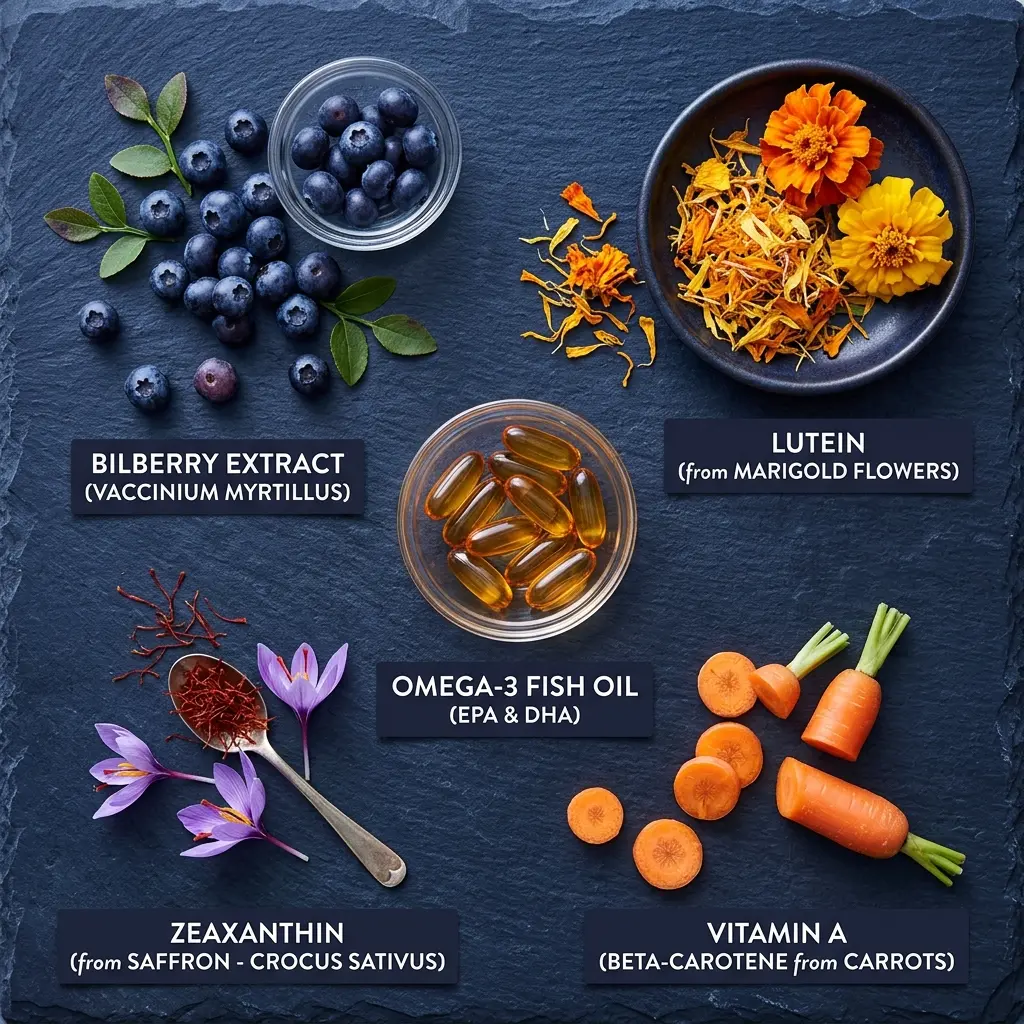
Bilberry Extract — Night Vision & Microcirculation
Evidence Level: Class B — Multiple RCTs showing night vision adaptation improvement; historical RAF documentation of operational use. The anthocyanin mechanism for rhodopsin regeneration is well-characterized biochemically. The retinal microcirculation benefits are supported by multiple small RCTs.
Clinical dose: 160-480mg standardized to 36% anthocyanins. Bilberry at non-standardized doses or at low amounts is meaningless.
Vitamin A / Beta-Carotene — Photoreceptor Function
Evidence Level: Class A for mechanism, Class B for supplementation in non-deficient adults. Vitamin A is directly incorporated into opsin proteins to form photopigments. Without it, rhodopsin cannot regenerate after light exposure — producing night blindness. In developed nations, overt deficiency is rare, but subclinical insufficiency affecting dark adaptation is common in processed-food diets.
Note: AREDS2 found beta-carotene (a Vitamin A precursor) increased lung cancer risk in smokers — it has been replaced by Lutein/Zeaxanthin in updated AMD formulas. Pure Vitamin A (retinyl palmitate) avoids this concern.
Omega-3 DHA — Retinal Membrane Integrity
Evidence Level: Class B — DHA constitutes 60% of the photoreceptor outer segment membrane lipid composition. It is essential for maintaining membrane fluidity that allows the conformational changes in rhodopsin required for phototransduction. DHA also has anti-inflammatory properties, and low omega-3 levels correlate with elevated dry eye risk. AREDS2 omega-3 supplementation did not show dramatic AMD progression reduction, but DHA's structural role in photoreceptor membranes is mechanistically sound.
Tier 3: Emerging Evidence (Promising but Preliminary)
Probiotics (Gut-Eye Axis)
Evidence Level: Class C moving to Class B — The gut-retina axis is one of the most exciting emerging areas in ophthalmology research. Multiple cross-sectional studies confirm the gut-AMD microbiome correlation. First RCTs are underway. Mechanistically, the connection is well-supported by the SCFA → complement regulation and carotenoid absorption enhancement pathways. This is an area where evidence is accumulating rapidly and VisiFlora's inclusion of probiotics is forward-thinking rather than speculative.
Astaxanthin — Broad Antioxidant
Evidence Level: Class C for vision specifically. Astaxanthin is a powerful antioxidant (10x stronger than Lutein in ORAC assays) but crosses the blood-retina barrier at lower efficiency than the retinal-specific carotenoids. Small trials show eye fatigue reduction — insufficient for AMD-prevention claims but potentially additive for digital eye strain.
Red Flags in Eye Supplements to Avoid
- Under-dosed Lutein: Products with 2-3mg Lutein instead of the clinical 10mg minimum — the AREDS2 dose. One-quarter of the evidence-based dose is not equivalent to a quarter of the benefit.
- No Zeaxanthin: Lutein alone is incomplete — macular pigment composition requires both carotenoids in proper ratio
- Beta-carotene instead of Lutein/Zeaxanthin: Outdated AREDS (original) formula; the AREDS2 update explicitly replaced beta-carotene with Lutein/Zeaxanthin
- Proprietary blend hiding individual doses: If you can't see how much Lutein is in the formula, assume it's inadequate
- No mention of standardization for Bilberry: "Bilberry 100mg" is meaningless without knowing the anthocyanin percentage
VisiFlora Formula Score vs. Category Benchmarks
| Criterion | Evidence Standard | VisiFlora | Typical Competitor |
|---|---|---|---|
| Lutein (10mg minimum) | Class A ✅ | ✅ Included | ⚠️ Often 2-5mg |
| Zeaxanthin (2mg minimum) | Class A ✅ | ✅ Included | ⚠️ Often absent |
| Zinc (25-80mg) | Class A ✅ | ✅ Included | ✅ Usually included |
| Bilberry Extract (standardized) | Class B ✅ | ✅ Included | ❌ Rarely included |
| Vitamin A/Retinal support | Class A mechanism | ✅ Included | ⚠️ Variable |
| Probiotic gut-eye support | Class C-B emerging | ✅ Unique feature | ❌ Not included |
| Money-back guarantee ≥60 days | Trust signal | ✅ 60-day | ⚠️ Often 30-day |
Digital Eye Strain: The Modern Vision Crisis
An emerging use case for eye supplements beyond AMD prevention: digital eye strain (computer vision syndrome). With the average adult now spending 7+ hours per day on digital devices, symptoms including eye fatigue, dryness, blurred vision, and headaches affect an estimated 50-90% of heavy computer users. The mechanism: sustained near-focus + high-intensity blue-light emission from LCD/OLED screens accelerates retinal oxidative stress and depletes macular pigment faster than natural light conditions.
Lutein and Zeaxanthin supplementation specifically for digital eye strain has been validated in multiple RCTs:
- A 2017 Foods RCT found 10mg Lutein + 2mg Zeaxanthin daily for 6 months significantly reduced visual fatigue symptoms in heavy computer users
- A 2018 Nutrients trial confirmed improvements in contrast sensitivity and reduced photostress recovery time in participants with high screen exposure
VisiFlora's formula addresses both the AMD-prevention use case and the digital eye strain use case through the same Lutein/Zeaxanthin carotenoid pathway — making it relevant for a much broader population than traditional eye supplements positioned exclusively for older adults.
Conclusion: The 2026 Best-in-Class Eye Health Formula
The ideal eye health supplement for 2026 should: include clinical-dose Lutein (10mg+) and Zeaxanthin (2mg+), add standardized Bilberry for night vision and microcirculation, provide Zinc and Vitamin A for photoreceptor metabolism, and ideally include the emerging gut-eye axis probiotic component that enhances the absorption and anti-inflammatory value of the entire formula.
VisiFlora is currently one of the only products that checks all of these boxes simultaneously — including the novel probiotic integration that places it significantly ahead of the formula curve compared to conventional eye health supplements.
For anyone experiencing digital eye strain, early macular concerns, night vision decline, or simply wanting to protect their long-term visual function, a 90-day trial of VisiFlora with pre/post macular pigment testing (available at many optometry offices) provides an objective, measurable evaluation of impact.