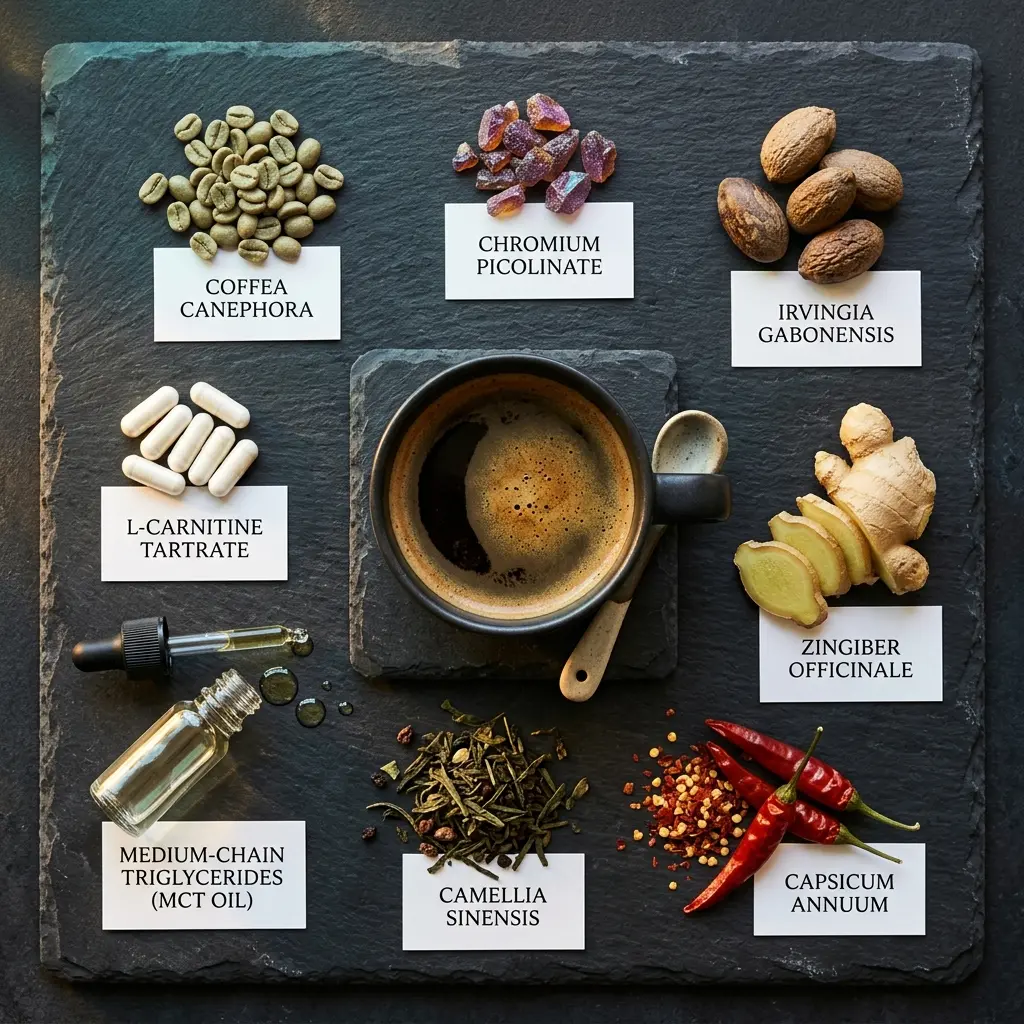
Best Metabolism Booster Supplements 2026: Coffee-Compatible Fat Burners Compared by Evidence
From green coffee bean to chromium, African mango to L-Carnitine — which metabolism boosters have real clinical evidence? We rank the most effective ingredients and compare the top products by formula quality.
The Metabolism Supplement Market: Separating Evidence from Hype
The global weight management supplement market exceeded $33 billion in 2024. Within this category, "metabolism boosters" and "fat burners" represent one of the most aggressively marketed niches — and one of the most frequently misrepresented. Many products rely on massive caffeine doses to produce the sensation of "working" without any meaningful fat oxidation beyond caffeine's own well-documented but limited effects.
This comparison ranks metabolism-boosting ingredients by evidence quality, mechanism specificity, and clinical dose requirements — providing a framework for identifying which products are substance vs. spectacle.
Tier 1: Strongest Clinical Evidence for Metabolic Support
Caffeine — The Gold Standard Thermogenic
Evidence: Class A. The most studied metabolic compound in human nutrition. 3-6mg/kg body weight increases metabolic rate by 3-11% over 3 hours through adrenergic stimulation (norepinephrine release) → β3-adrenergic receptor activation on adipocytes → lipolysis. Fat oxidation increases by 10-29% in lean individuals and 10% in obese individuals at clinical doses. Tolerance develops with chronic use — requiring cycling to maintain effect.
Clinical dose in supplement context: 100-400mg per serving (depends on individual caffeine tolerance).
Note: Adding a metabolism drop formula to existing daily coffee uses the caffeine the consumer is already consuming — a practical advantage over adding additional caffeine supplements.
Green Coffee Bean Extract (Chlorogenic Acids) — Glucose & AMPK
Evidence: Class A — Multiple RCTs confirming weight reduction and glucose-lowering effects.
Mechanism: Dual inhibition of SGLT1 (intestinal glucose transport) and glucose-6-phosphatase (hepatic glucose output) reduces glycemic load of meals → lower insulin spikes → reduced lipogenic signaling → improved metabolic flexibility. AMPK activation increases cellular fat oxidation independently of insulin signaling. Chlorogenic acids lost in roasting — green coffee extract restores them.
Clinical dose: 400-800mg standardized green coffee extract per day. Higher doses needed than typical brewed coffee provides.
Chromium Picolinate — Insulin Signaling
Evidence: Class A for insulin sensitivity — 15 RCT meta-analysis confirming glucose reduction in type 2 diabetes; carbohydrate craving reduction in 2 double-blind crossover trials.
Mechanism: Chromodulin potentiates insulin receptor tyrosine kinase → improved glucose uptake with lower insulin requirement → reduced hyperinsulinemia → less lipolysis suppression. Also modulates serotonin synthesis pathway — mechanistically related to carbohydrate craving reduction.
Clinical dose: 200-1000mcg chromium picolinate per day. Picolinate form has 3-5x better absorption than chromium chloride.
EGCG (from Green Tea Extract) — Catecholamine Amplifier
Evidence: Class A — International Journal of Obesity meta-analysis (11 RCTs) confirming weight reduction; well-characterized COMT inhibition mechanism.
Mechanism: EGCG inhibits COMT (catechol-O-methyltransferase) → prolonged norepinephrine activity → extended duration of caffeine-induced lipolytic effect. This is why the EGCG-caffeine combination (as in green tea, or EGCG supplementation with coffee) has consistently superior metabolic effects compared to either compound alone. AMPK activation increases fat oxidation in muscle tissue.
Clinical dose: 400-600mg EGCG daily for metabolic effects. Most "green tea extract" products at 100-200mg are subtherapeutic for meaningful fat oxidation effects.
Tier 2: Good Evidence for Specific Metabolic Functions
L-Carnitine — Fatty Acid Mitochondrial Transport
Evidence: Class B-A for exercise fat oxidation; mixed results in sedentary populations — the exercise context is critical.
Mechanism: L-Carnitine is required for CPT1-mediated transport of long-chain fatty acids across the inner mitochondrial membrane — the rate-limiting step for fat oxidation. Without adequate carnitine, mobilized free fatty acids cannot be oxidized regardless of lipolytic activity. Particularly important during aerobic exercise, when fatty acid oxidation rate is highest and carnitine availability becomes limiting.
Key synergy with caffeine: Caffeine increases circulating free fatty acid levels by 20-40%; L-Carnitine ensures those fatty acids can actually enter mitochondria for oxidation. This is a genuinely additive combination.
Clinical dose: 1500-3000mg L-Carnitine tartrate per day. Tartrate form has superior bioavailability to L-Carnitine base or ALCAR for peripheral tissue uptake.
African Mango (Irvingia gabonensis) — Adiponectin & Metabolic Hormone
Evidence: Class B — 2 published RCTs with impressive results; needs larger independent replication.
Mechanism: Increases adiponectin secretion from adipocytes — addressing the adiponectin-deficiency trap common in overweight individuals. Also inhibits glycerol-3-phosphate dehydrogenase (G3PD − involved in triglyceride synthesis) and amylase/glucosidase (reducing carbohydrate digestion). The 2009 RCT showing 160% adiponectin increase + 12.8lb weight loss vs. placebo remains one of the most striking outcomes in weight management supplement research.
Capsaicin — BAT Activation & Thermogenesis
Evidence: Class A for thermogenesis; multiple RCTs confirming metabolic rate increase and appetite reduction.
Mechanism: TRPV1 activation → sympathetic activation of brown adipose tissue → UCP1 expression → non-shivering thermogenesis. Simultaneously activates satiety signaling through cholecystokinin (CCK) and glucagon-like peptide 1 (GLP-1) → reduced caloric intake at subsequent meals. A 2012 AJCN meta-analysis confirmed 50 kcal/day increased energy expenditure — modest individually but significant over time and synergistic with other thermogenic compounds.
Ginger Root Extract — Thermogenic & Anti-Inflammatory
Evidence: Class B — 2018 meta-analysis (14 RCTs) confirming weight and waist reduction.
Mechanism: Gingerols activate TRPV1 similarly to capsaicin — additive thermogenic effect when combined. Additionally reduces chronic metabolic inflammation (via NF-κB inhibition) that drives insulin resistance independent of body weight. Improves gastric motility and satiety signaling.
Red Flags: Metabolism Supplement Ingredients That Underperform
- Raspberry ketones: Convincing in rat studies at doses equivalent to ~800lbs of raspberries/day in humans; zero well-designed human clinical trials. Almost certainly ineffective at realistic doses.
- Garcinia Cambogia (HCA): Initial trial data looked promising; larger independent RCTs (including a 2011 JAMA study, n=135) found no significant weight loss vs. placebo. Two independent meta-analyses confirm small, non-clinically-meaningful effects at best.
- CLA (Conjugated Linoleic Acid): Multiple RCTs but effect size is extremely small — approximately 0.2kg fat mass reduction per month. Not meaningfully impactful for most users despite a large marketing footprint.
- Stimulant-only formulas: Products containing primarily caffeine, synephrine, and yohimbine activate adrenergic fat mobilization without addressing mitochondrial oxidation capacity, insulin sensitivity, or adiponectin — leading to liberated fatty acids that are simply re-esterified without additional metabolic support.
Metabo Drops Formula Score vs. Category Benchmarks
| Ingredient | Evidence Tier | Mechanism | In Metabo Drops |
|---|---|---|---|
| Caffeine (via coffee integration) | Tier 1 ✅ | Adrenergic lipolysis + thermogenesis | ✅ (via coffee) |
| Green Coffee (Chlorogenic Acids) | Tier 1 ✅ | SGLT1 inhibition + AMPK + glucose regulation | ✅ Yes |
| Chromium Picolinate | Tier 1 ✅ | Insulin sensitivity + craving reduction | ✅ Yes |
| EGCG (Green Tea Extract) | Tier 1 ✅ | COMT inhibition + caffeine synergy | ✅ Yes |
| L-Carnitine Tartrate | Tier 2 ✅ | Mitochondrial fatty acid transport | ✅ Yes |
| African Mango | Tier 2 ✅ | Adiponectin + G3PD inhibition | ✅ Yes |
| Capsaicin/Cayenne | Tier 2 ✅ | BAT activation + thermogenesis | ✅ Yes |
| Ginger Extract | Tier 2 ✅ | Thermogenic + anti-inflammatory | ✅ Yes |
| Raspberry Ketones | Tier 3 ❌ | No human evidence | ✅ Not included |
| Garcinia Cambogia | Tier 3 ❌ | Inconsistent human trials | ✅ Not included |
Metabo Drops achieves a near-perfect ingredient quality score against our evidence framework — covering all four major evidence-backed metabolic mechanisms (thermogenesis, glucose regulation, fatty acid oxidation capacity, adiponectin hormonal environment) while avoiding the category's common placeholder ingredients.
Conclusion: What to Look for in a Metabolism Supplement
The best metabolism-supporting supplements in 2026 share these characteristics:
- Multi-pathway formula rather than stimulant-only
- Ingredients with published human clinical trial data
- Doses that align with clinically-studied ranges
- Evidence base that covers both fat mobilization AND fat oxidation
- Insulin sensitivity support alongside thermogenic compounds
- No reliance on ingredients with only animal-model evidence
Metabo Drops meets all six criteria — and its coffee-compatible delivery mechanism makes it uniquely practical for the millions of adults who drink coffee daily, turning an existing habit into an optimized metabolic protocol without adding another supplement step to a busy morning.