Patch Berbérine vs. Gélules : Quelle Méthode Donne de Meilleurs Résultats ? (2026)
Toutes les berbérines ne se valent pas. Le mode d'administration change fondamentalement la biodisponibilité, la tolérance et l'efficacité. Nous analysons la berbérine transdermique vs. orale — et laquelle convient le mieux à vos objectifs.
The Berberine Delivery Problem Nobody Talks About
Berberine has extraordinary clinical evidence — comparable to metformin for blood sugar management, meaningful weight loss in 12-week trials, significant cholesterol improvements, and AMPK activation that underlies all of these effects. Yet despite this evidence, there's a well-known problem: oral bioavailability of berberine is poor.
Studies estimate that only 5-20% of ingested berberine reaches systemic circulation. The rest is either not absorbed from the gut, broken down by gut bacteria (ironically, this gut interaction is also partly responsible for berberine's benefits through microbiome modulation), or metabolized in the liver before it can enter the bloodstream (the "first-pass effect").
This has led supplement formulators to explore an alternative: transdermal delivery — patches that deliver berberine through the skin directly into the bloodstream, bypassing both the gut and first-pass liver metabolism entirely.
This guide analyzes both approaches across five key factors: bioavailability, tolerability, convenience, cost, and formula synergy.
Factor 1: Bioavailability — How Much Berberine Actually Reaches Your Blood
Oral Berberine
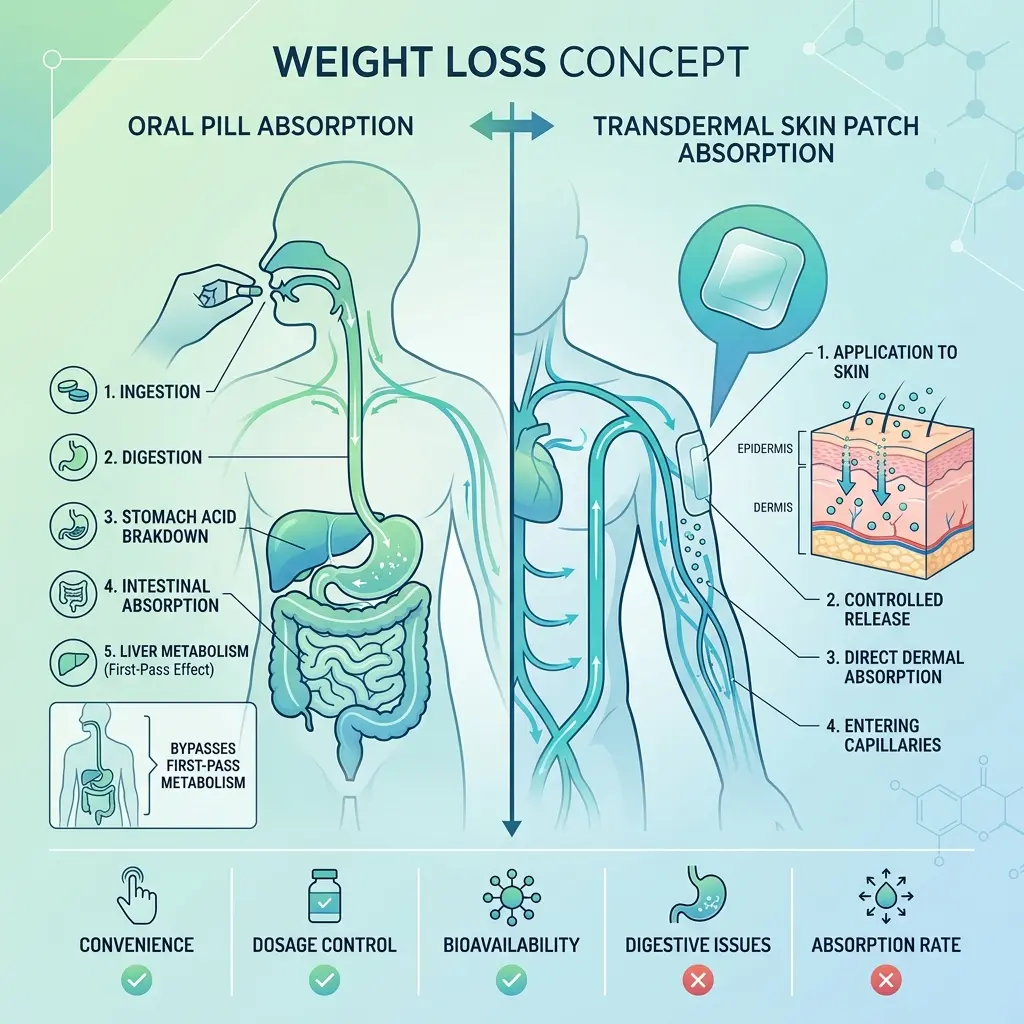
Oral berberine faces the "first-pass" gauntlet:
- Capsule dissolves in stomach
- Berberine absorbed through intestinal wall (limited by P-glycoprotein efflux pumps that actively pump berberine back into the gut)
- Absorbed berberine reaches liver via portal circulation where CYP enzymes immediately metabolize a significant portion
- Remaining berberine enters general systemic circulation
Result: estimated 5-20% bioavailability depending on formulation, individual gut microbiome composition, and concurrent food/medication interactions.
Strategies to improve oral berberine bioavailability: Liposomal encapsulation (shown to increase absorption ~10x in some studies), amorphous solid dispersions, nanoemulsions. Standard berberine HCl capsules have the lowest bioavailability; advanced formulations improve this significantly.
Transdermal Berberine (Patch)
Transdermal delivery bypasses the entire oral absorption and first-pass metabolism pathway:
- Patch applied to skin surface
- Berberine diffuses through the stratum corneum (outer skin layer) via concentration gradient
- Enters capillaries in the dermis
- Directly enters systemic venous circulation without passing through intestines or liver
Theoretical advantage: 100% of absorbed berberine from the patch reaches systemic circulation without first-pass degradation.
The challenge: skin is designed as a barrier. Berberine (MW 336 Da) sits at the upper limit of optimal transdermal absorption (typically molecules under 500 Da, lipid-soluble, non-ionized). Penetration enhancers like pomegranate seed oil (used in Purisaki) significantly improve flux across the skin barrier.
Honest assessment: Direct comparison studies between oral and transdermal berberine bioavailability in humans are limited. Animal studies suggest transdermal delivery can achieve 40-70% of the plasma levels of equivalent oral doses with appropriate penetration enhancement — potentially superior actual bioavailability compared to standard oral berberine despite lower absolute dose delivery.
Factor 2: Tolerability — The GI Side Effect Reality
Oral Berberine: The Dirty Secret
In clinical trials, oral berberine consistently produces gastrointestinal adverse events in a significant proportion of users:
- Nausea: reported in 15-25% of users
- Constipation or diarrhea (alternating): 20-30%
- Abdominal cramping: 15-20%
- Bloating and flatulence: 15-20%
These effects are largely dose-dependent and often resolve after 2-3 weeks as the gut microbiome adapts. However, many users discontinue before adaptation occurs — dramatically reducing real-world effectiveness compared to clinical trial outcomes (where participants are monitored and encouraged to persist).
The mechanism: berberine's antimicrobial properties alter gut bacteria populations rapidly, causing temporary dysbiosis and the associated symptoms. It also inhibits intestinal smooth muscle, potentially contributing to motility changes.
Transdermal Berberine: GI-Free Profile
By entirely bypassing the gastrointestinal tract, transdermal delivery eliminates these side effects completely. The GI tract never contacts the berberine compound — it absorbs directly through skin into capillaries.
The trade-off: a small percentage of users (estimated 5-8%) experience mild local skin reactions at the patch site — redness, itching, or mild irritation. This is manageable by rotating application sites and typically resolves after the first week.
For the 30-35% of people who discontinue oral berberine due to GI side effects, transdermal delivery is not just more convenient — it may be the only format they can actually sustain long-term, making it definitively more effective by enabling compliance.
Factor 3: Convenience — Daily Protocol Reality
| Aspect | Oral Capsules | Transdermal Patch |
|---|---|---|
| Dosing frequency | 2-3x daily (with meals) | Once daily |
| Food timing | Must coordinate with meals | No food coordination needed |
| Travel convenience | Needs pill organizer, meal awareness | Single patch, wear all day |
| Compliance risk | Missed doses (busy days, dining out) | Low (once-daily morning routine) |
| Discretion | Visible pill-taking | Hidden under clothing |
| Reminder needed | Phone alarm or pill box | Integrated into morning routine |
Supplement compliance is one of the most underappreciated factors in real-world effectiveness. The best supplement is the one you actually take consistently. For many adults, a once-daily patch that's part of a morning routine dramatically outperforms a 3x-daily capsule protocol in sustained compliance — even if the oral format has slightly superior pharmacokinetics on paper.
Factor 4: Formula Synergy — What Comes With Your Berberine
Typical Oral Berberine
Most oral berberine supplements contain: berberine HCl (500mg) + sometimes a bioperine (black pepper extract) for absorption enhancement. Rarely include additional metabolic ingredients at meaningful doses due to capsule volume limitations.
Purisaki Berberine Patch Formula
The patch format allows formulators to include a comprehensive ingredient blend delivered simultaneously over 24 hours:
- Berberine Extract: Core AMPK activator and blood sugar management
- Fucoxanthin: Marine carotenoid thermogenic — activates UCP-1 in white adipose tissue, promoting brown fat-like calorie burning behavior. Multiple Japanese RCTs show significant fat mass reduction.
- Green Tea Extract (EGCG): Complements berberine's AMPK activation; independent thermogenic and antioxidant effects; cardiovascular support
- African Mango Extract (IGOB131): Clinically validated for weight, waist circumference, and blood glucose reduction over 10 weeks
- Pomegranate Seed Oil: Penetration enhancer + punicic acid (anti-adipogenic conjugated fatty acid)
- Vitamins C, B1, B3: Energy metabolism cofactors + vasodilation support (niacin)
The combined formula targets AMPK activation (berberine), thermogenesis (fucoxanthin, EGCG), appetite-weight-glucose (African Mango), and skin permeation (pomegranate oil) simultaneously — a more comprehensive metabolic approach than single-ingredient oral berberine.
Factor 5: Cost Analysis
| Format | Monthly Cost | Effective Dose/Day | Note |
|---|---|---|---|
| Standard Berberine HCl (500mg×2) | $15-30 | 1,000mg (low bioavailability) | Lowest cost; GI risk |
| Advanced Oral Formula (liposomal/nano) | $40-70 | 500-1,000mg (higher bioavailability) | Better absorption; still GI risk |
| Purisaki Berberine Patch (3-box) | ~$59/box | Transdermal dose + 5 additional ingredients | GI-free; convenient; multi-ingredient |
Purisaki costs more per month than basic oral berberine. However, when accounting for the comprehensive formula, GI-free profile, compliance advantages, and the value of actually completing a full 90-day protocol (vs. discontinuing due to side effects), the cost-effectiveness case for the patch format is stronger than it appears at face value.
Who Should Choose Which Format?
Choose oral berberine if:
- Budget is a primary constraint
- You've used oral berberine before without GI issues
- You prefer the established research base of the oral route
- You're combining with other capsule/pill supplements
Choose transdermal (Purisaki Patch) if:
- You've experienced GI side effects with oral berberine previously
- You prefer once-daily convenience over multiple doses
- You want a comprehensive multi-ingredient metabolic formula
- Compliance has been your challenge with other supplement protocols
- You have a sensitive digestive system
The Bottom Line: Both Work — Format Is a Personal Decision
Both oral berberine and transdermal berberine patches deliver the metabolic benefits of this extensively studied alkaloid. The choice between them comes down to your individual priorities: cost, tolerability, convenience, and formula comprehensiveness.
For those who have struggled with oral berberine's GI effects — or who simply prefer the practicality of a once-daily patch — Purisaki Berberine Patch represents a well-formulated transdermal alternative that addresses the primary barriers to consistent berberine supplementation.
As always, consult your healthcare provider before starting berberine supplementation, particularly if you are on blood sugar medications or have existing health conditions.