Die Wissenschaft von Stoffwechsel & Thermogenese: Wie Ihr Körper Fett Verbrennt (2026)
Warum scheinen manche Menschen alles essen zu können und schlank zu bleiben? Die Antwort liegt in Ihrer Stoffwechselrate, Thermogenese und braunem Fettgewebe.
The Metabolism Myth: Why "Slow Metabolism" Is Both Real and Misunderstood
If you've ever felt your metabolism is "slow" or watched someone eat freely without gaining weight, you've encountered one of health science's most frequently mythologized topics. The truth is simultaneously more complex and more actionable than popular culture suggests.
Your resting metabolic rate (RMR) — the calories your body burns simply to maintain basic physiological functions at rest — varies between individuals by up to 20% independent of body size. That differential can amount to 300-400 calories per day — the equivalent of a significant snack or a 45-minute jog. Understanding what drives this variation is the key to understanding metabolic optimization.
The Four Components of Total Daily Energy Expenditure
1. Basal Metabolic Rate (BMR) / Resting Metabolic Rate (RMR)
The calories burned at rest to maintain: core temperature, cardiac function, respiratory mechanics, kidney filtration, immune surveillance, and neural activity. Comprises approximately 60-75% of total daily energy expenditure (TDEE) in sedentary adults. The major determinants:
- Lean mass (muscle): Each kilogram of skeletal muscle burns approximately 13 kcal/day at rest. Fat tissue burns approximately 4.5 kcal/kg/day. This is why resistance training is a long-term metabolic investment — each pound of muscle added raises your BMR permanently.
- Thyroid hormone status: T3 (triiodothyronine) is the primary metabolic rate regulator in every cell. Even subclinical hypothyroidism (TSH slightly elevated, T4 within normal range) can reduce BMR by 5-15%.
- Age: BMR declines approximately 1-2% per decade after age 30 — partially due to hormonal changes, but significantly due to progressive loss of metabolically active lean tissue (sarcopenia) that begins in the 4th decade. Maintaining muscle mass remains the primary anti-aging metabolic strategy.
- Brown adipose tissue (BAT) content: Covered in detail below — BAT is thermogenically active fat that burns calories rather than storing them.
2. Thermic Effect of Food (TEF)
The calories burned digesting, absorbing, and metabolizing food. Proteins have the highest TEF (20-35% of calories consumed) — meaning 30% of protein calories are "spent" just processing the protein. Carbohydrates: 5-10%. Fats: 0-3%.
Practical implication: a high-protein diet provides a metabolic advantage of approximately 25-35% efficiency reduction in net caloric utilization of protein calories vs. fat calories. This is why high-protein diets consistently outperform low-protein diets for weight management in metabolic studies — independent of total caloric intake.
3. Physical Activity Energy Expenditure (PAEE)
The most variable and controllable component — ranging from near-zero in highly sedentary individuals to 50%+ of TDEE in elite athletes. Importantly, this includes not just formal exercise but all non-exercise activity thermogenesis (NEAT): fidgeting, postural control, stair-climbing, and walking all contribute meaningfully.
4. Non-Exercise Activity Thermogenesis (NEAT)
NEAT is the metabolic wild card — it varies by up to 2,000 kcal/day between individuals of similar body composition. High-NEAT individuals (spontaneous fidgeters, walkers, gesticulators) burn dramatically more calories without conscious exercise than low-NEAT individuals. NEAT is partly neurologically hardwired but can be deliberately increased through environmental design (standing desk, step tracking, activity breaks).
Brown Adipose Tissue: The Fat That Burns Fat
One of the most significant discoveries in metabolic science over the past 20 years has been the recognition that human adults retain functionally significant deposits of brown adipose tissue (BAT) — previously thought to exist only in infants and hibernating mammals.
What Is Brown Adipose Tissue?
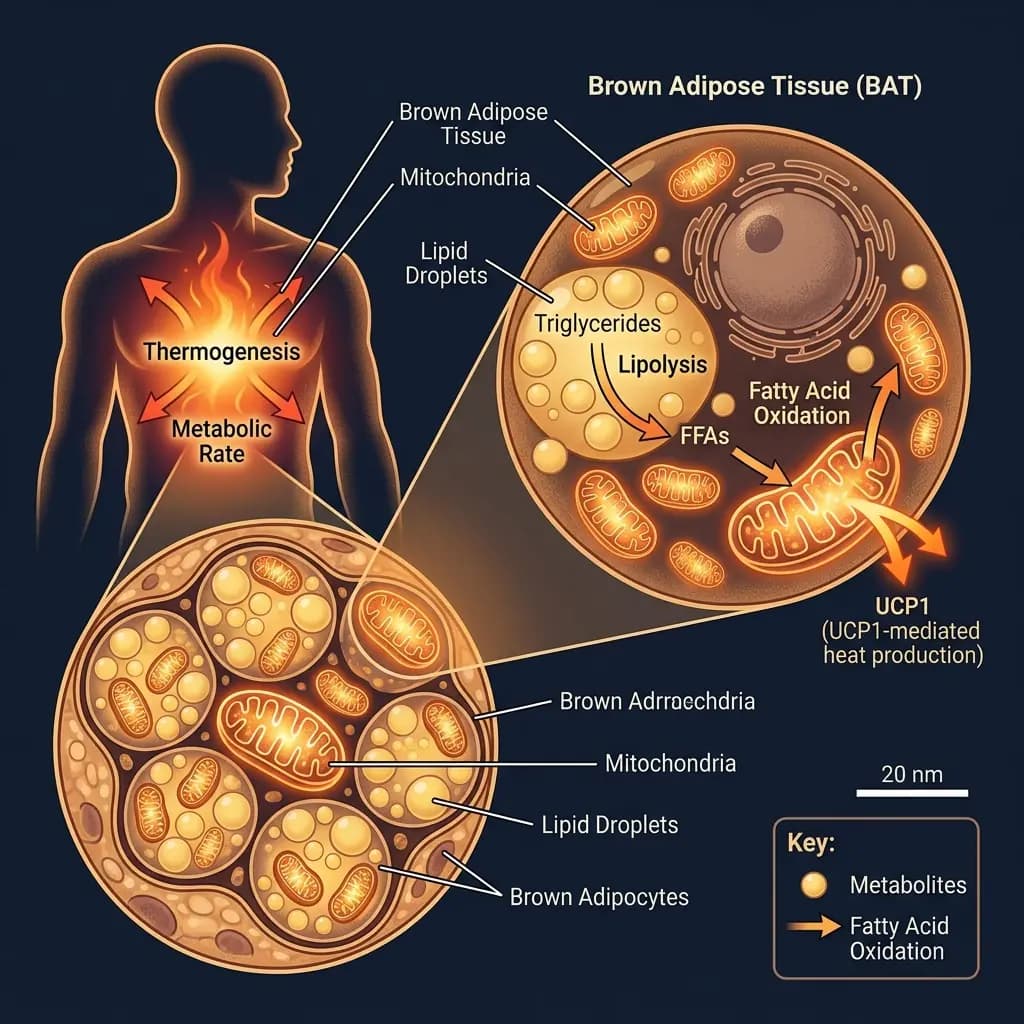
BAT differs from white adipose tissue (WAT — the fat you want to lose) in a critical way: BAT mitochondria express UCP1 (uncoupling protein 1), which short-circuits the electron transport chain → instead of capturing the energy released from fat oxidation as ATP, it dissipates the energy as heat. This is non-shivering thermogenesis — calorie burning without movement.
A single gram of maximally activated BAT burns approximately 300× more calories than a gram of white fat. In humans, significant BAT deposits are located in the supraclavicular fossa (above the collarbones), paravertebral region, and around the kidneys. In PET/CT scans measuring cold-activated BAT, younger adults typically show more BAT than older adults.
What Activates Brown Adipose Tissue?
- Cold exposure: The most potent BAT activator. Cold-induced sympathetic nervous system activation releases norepinephrine → β3-adrenergic receptor activation on BAT → UCP1 expression → thermogenesis. Practical: cold showers, cool sleeping environment (65-68°F), winter outdoor activity.
- Capsaicin (from chili peppers): Activates TRPV1 receptors which mimic the cold/heat sensing pathway → sympathetic activation of BAT. 12-week capsaicin supplementation trials show measurable increases in BAT activity.
- Exercise: Muscle-derived irisin (released during aerobic exercise) promotes browning of white adipose tissue (WAT → beige/brite fat) — the same UCP1 expression shift that characterizes BAT.
- Catecholamine-stimulating compounds: Caffeine, green tea EGCG, and synephrine all amplify adrenergic signaling → enhanced BAT thermogenesis. This is the thermogenic mechanism behind fat-burning supplements containing these compounds.
Adiponectin: The Anti-Obesity Hormone You've Never Heard Of
While leptin (the "satiety hormone") and ghrelin (the "hunger hormone") have become household names in obesity science, adiponectin — arguably the most metabolically important adipose-derived hormone — remains relatively unknown outside clinical research.
Adiponectin is secreted by fat cells and exerts opposite effects to those you'd expect from a fat-derived hormone:
- Increases insulin sensitivity in muscle and liver
- Increases fatty acid oxidation (fat burning) through AMPK activation
- Reduces hepatic glucose output
- Has anti-inflammatory effects (reduces TNF-alpha and IL-6)
- Correlates negatively with cardiovascular disease risk
Paradoxically, adiponectin levels are LOWER in obese individuals despite having more fat tissue — because large, lipid-engorged fat cells secrete less adiponectin than small, healthy fat cells. This creates a metabolic trap: more fat → lower adiponectin → worse insulin sensitivity → more fat accumulation. Breaking this cycle requires either significant weight loss (which eventually restores adiponectin) or interventions that directly increase adiponectin without requiring prior weight loss first.
African Mango seed extract (Irvingia gabonensis) is one of the few compounds with published RCT data showing direct adiponectin elevation — making it mechanistically important in the context of breaking the obesity-adiponectin trap.
Insulin Resistance and Metabolic Rate
Insulin resistance — the condition in which cells require increasingly higher insulin concentrations to achieve the same glucose uptake — is both a consequence and a driver of slowed metabolism:
- Hyperinsulinemia (chronically elevated insulin) directly suppresses lipolysis — insulin is the primary anti-fat-burning signal. High insulin = fat cells locked shut for fat mobilization regardless of caloric deficit.
- Insulin resistance in skeletal muscle shunts glucose away from muscle glycogen synthesis toward hepatic lipogenesis (fat synthesis in the liver) → fatty liver → worsened metabolic flexibility
- The insulin-carbohydrate craving cycle: insulin resistance → impaired glucose uptake → brain glucose shortage perception → carbohydrate cravings → more glucose → more insulin → worsened resistance
Chromium picolinate's documented carbohydrate craving reduction is therefore mechanistically connected to this cycle — by improving insulin receptor sensitivity, it reduces the biological drive toward carbohydrate overconsumption.
Chlorogenic Acids and Glucose Regulation
Chlorogenic acids (the primary polyphenols in green coffee bean extract) reduce postprandial blood glucose through a dual mechanism:
- Inhibition of sodium-glucose cotransporter 1 (SGLT1) in the intestinal epithelium → reduced active glucose absorption from the gut lumen
- Inhibition of glucose-6-phosphatase in hepatocytes → reduced hepatic glucose output → lower fasting and post-meal glucose
Lower post-meal glucose → lower insulin spike → reduced lipogenic signaling → better metabolic flexibility. This is the mechanism by which regular coffee consumption correlates with 25-35% reduced type 2 diabetes risk in large epidemiological cohorts — and why green coffee extract (with much higher chlorogenic acid content than roasted coffee) magnifies this effect.
The Coffee-Metabolism Protocol in Practice
Based on the convergent evidence, the most metabolically optimized morning protocol includes:
- Morning sunlight exposure within 30 minutes of waking — anchors cortisol peak, improves leptin sensitivity, maximizes fat mobilization window
- Delay coffee 60-90 minutes after waking — allows natural cortisol to peak before adding caffeine (prevents blunting, optimizes timing)
- Take Metabo Drops in morning coffee — chlorogenic acid + chromium + L-Carnitine + cayenne amplify coffee's metabolic effects across multiple complementary pathways
- Protein-first breakfast — if eating breakfast, lead with protein to use TEF advantage and prevent glucose spike from carbohydrates
- Aerobic activity within 90 minutes of coffee + drops — maximizes L-Carnitine fat transport + caffeine fat mobilization synergy during exercise
Conclusion: Metabolism Is Modifiable
The research is clear: metabolic rate is not fixed destiny. Brown adipose tissue can be activated; insulin sensitivity can be improved; adiponectin can be elevated; thermogenesis can be amplified. Each of these levers is modifiable through diet, activity, cold exposure, and targeted supplementation.
Products like Metabo Drops — built around the evidence-based intersection of coffee's own metabolic properties with clinically-investigated additions — represent a rational, multi-mechanism approach to metabolic enhancement that goes well beyond the stimulant-only fat burner category.